Lumber terms, defined
What Is a Board Foot?
A board foot is 144 cubic inches of lumber — the amount of wood in a board 12 inches wide, 12 inches long, and 1 inch thick. It is a unit of volume, which is exactly why it trips people up: it isn't the surface you see, it's the wood you're paying for. Once you've got the definition, calculating board feet is one short formula.
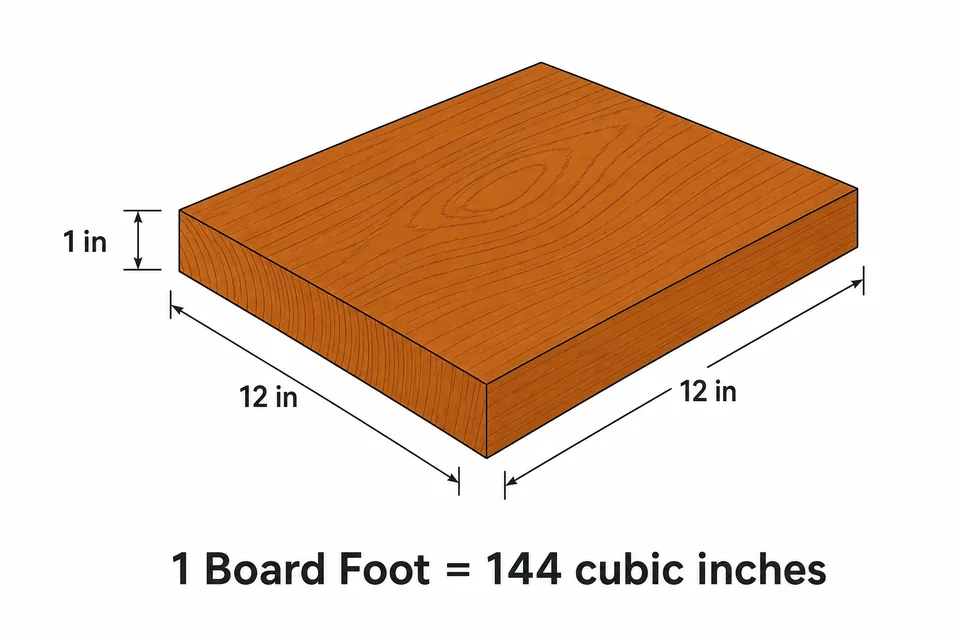
The first time I tallied a rack of rough walnut as a young buyer, I made the classic mistake — I counted the faces of the boards like square footage and landed on exactly half the dealer's number. The boards were 8/4, twice as thick as I'd assumed. That afternoon taught me what a board foot really is, and it's the one definition every lumber buyer has to get into their bones.
Here are the numbers behind that afternoon. The rack was 30 boards of 8/4 walnut, 10″ wide and 9′ long. Counting faces, I had 7.5 square feet a board and told myself 225 "units" of lumber. Counting volume, each board is 2 × 10 × 9 ÷ 12 = 15 BF, which makes the rack 450 board feet. At $13 a board foot that's a $5,850 bill against the $2,925 I'd mentally written. Twice the thickness, twice the wood, twice the price.
Why does a board foot measure volume, not area?
Two boards can cover the same wall yet contain very different amounts of wood, because one might be twice as thick. Pricing by area would let a buyer pay the same for half the material. Board feet fix that by counting volume, so a 2-inch-thick slab is correctly worth twice a 1-inch board of the same face size. That is the entire reason the unit exists.
Think of it as the wood's "weight class." A square foot tells you how much surface a board covers; a board foot tells you how much actual timber is there. When a dealer quotes "$13 a board foot," they're pricing the volume of material, not the footprint, which is the only fair way to compare a thin 4/4 plank against a chunky 8/4 turning blank.
Why isn't lumber sold by weight?
Because wood is part water, and the water leaves. Freshly sawn ("green") hardwood commonly carries 40–80% of its oven-dry weight in moisture; air-dried stock is down around 15–20% and kiln-dried closer to 6–8%. Run that arithmetic on a single board: one at 60% moisture content weighs 1.60 times its oven-dry mass, and dried to 15% it weighs 1.15 times — so it sheds about 28% of its own scale weight while its volume moves by only a few percent of shrinkage. Weigh lumber at the mill and every pile would quietly re-price itself as it sat in the yard.
Density adds the same problem from the other direction. One board foot of white oak lands near 4 pounds air-dry; one board foot of ponderosa pine is closer to 2 — the identical 144 cubic inches, at half the mass. A pound-price would make oak look expensive and pine look cheap regardless of how much timber anyone actually got.
So weight measures the freight, not the timber, which is why it only earns a place in the calculation when you are loading a truck. For that use the numbers belong in the board foot weight calculator, which carries the species table rather than re-arguing the unit here.
How big is one board foot, physically?
A board foot is always 144 cubic inches, but the shape it takes depends entirely on how thick the stock is. Hold the width at a common 6″ and one single board foot stretches or shrinks like this:
| Thickness | Hardwood call | Face area in 1 BF | Length at 6″ wide |
|---|---|---|---|
| 0.50″ | 2/4 | 2.00 sq ft | 48″ (4 ft) |
| 0.75″ | 3/4 | 1.33 sq ft | 32″ |
| 1.00″ | 4/4 | 1.00 sq ft | 24″ |
| 1.50″ | 6/4 | 0.67 sq ft | 16″ |
| 2.00″ | 8/4 | 0.50 sq ft | 12″ |
| 2.50″ | 10/4 | 0.40 sq ft | 9.6″ |
Read the last two columns as a rule of thumb: double the thickness, halve the lumber you get from one board foot. That's the whole reason a stubby 8/4 turning blank can cost more than a long, thin board that covers four times the wall. Per-foot pricing by size lives in the board foot cheat sheet if you want the table for the yard.
The same 144 cubic inches, in five different shapes
Widen the exercise and let the width move too, holding the volume fixed at exactly one board foot:
| Thickness × width × length | What it looks like | Cubic inches | Board feet |
|---|---|---|---|
| 1″ × 12″ × 12″ | The textbook square foot of 1″ stock | 144 | 1.00 |
| 2″ × 6″ × 12″ | A stubby section of 6/4 board | 144 | 1.00 |
| 1″ × 6″ × 24″ | Two feet of a 1×6 | 144 | 1.00 |
| 1″ × 3″ × 48″ | Four feet of 1×3 trim | 144 | 1.00 |
| 4″ × 4″ × 9″ | A newel-post offcut | 144 | 1.00 |
A flat panel, a four-foot stick of trim and a nine-inch block of post all bill as exactly one board foot. That is the point of the unit, and the reason the eye is useless on a pile: a board foot is not a size of board, it is 144 cubic inches wearing whatever shape the sawmill left it in. If you caught yourself picturing a 1×12 when you read "one board foot," that picture is the misconception to drop.
What does "board footage" mean — is it a different unit?
No. Board footage is the same 144 cubic inches, only used as a different kind of word. "Board feet" is countable: you can have three of them or nine hundred, and you ask how many. "Footage" is not — it names the bulk the way "mileage" does, so you ask how much and you never pluralise it. There is a lot of board footage in that rack; there are 450 board feet in it.
At the counter both forms get answered with the same number, and the same number goes on the invoice. The difference is only which question sounds natural: "How much board footage is in this rack?" when somebody wants the total of a mixed pile, "How many board feet is that?" when one dimension is on the table.
That wobbly plural is half the reason people look up the board feet meaning at all — they have seen "feet" where they expected "foot" and assumed two different units. There is only one unit. One board foot, nine board feet, four hundred and fifty board feet: the measure never changes, only the grammar does. The single rule worth keeping is that the plural vanishes when the unit turns into an adjective — you place a 450-board-foot order, never a 450-board-feet order, exactly as you buy a ten-foot board rather than a ten-feet board.
One trap worth knowing: outside the lumber trade, "footage" on its own often means linear feet — a framer asking for "sixty feet of footage" for plate stock means sixty feet, not sixty board feet. When the conversation is trim, baseboards or fencing, say the full term "board feet" and you will not be quoted the wrong unit. If you want that conversion deliberately, it lives on the board feet to linear feet page.
Where did the board foot come from?
The board foot is an old American sawmill unit, built so a mill could price irregular hardwood by a single common measure. Hardwood doesn't come in tidy widths the way framing lumber does — a log yields random-width boards — so counting pieces or linear feet would be meaningless. Volume was the equalizer, and 144 cubic inches (a 1-inch board, one foot square) became the standard slug. More than a century later, the National Hardwood Lumber Association still grades and tallies by it, and that's why your hardwood invoice reads in board feet while the home center sells you studs by the piece.
Where the word "board" draws its line
Ask what separates a board from a plank and you find out fast: nobody at the yard answers in cubic inches. The answer is thickness, and it is a much older rule than the board foot itself. A trade manual of the period put the whole family of sawn shapes in order:
Planks are pieces of sawn timber from 2 in. to 6 in. thick, 11 in. to 18 in. wide, and from 8 ft. and upward in length. Deals are from 2 in. to 4 in. thick and 9 in. wide. Battens are from 4½ in. to 7 in. wide, and from 2 in. to 4 in. thick. Boards are pieces of sawn timber of any length and breadth, but not exceeding 2 in. in thickness. Scantlings are pieces of timber which have been sawn to 4 in. by 4 in., 4 in. by 3 in., 4 in. by 2 in., 3 in. by 3 in., 3 in. by 2 in., etc. The smallest pieces are frequently called quarterings.
— Cassell's Carpentry and Joinery, 1907
Read the arithmetic hiding in that list. Length and width are allowed to wander — "any length and breadth" — and the only thing held fixed is thickness, two inches. The trade sorted timber by how thick the saw left it, and the board foot is built the same way: it normalises the other two dimensions to a foot square and lets the inch of thickness carry the count. That is why 144 cubic inches is the slug, and why the formula keeps thickness in inches while width and length go to feet. A board foot and a "board" are conventions from the same habit of mind.
The same page of that book also shows how far these labels drifted from the saw. A "deal" was fixed at 9 inches wide, a "scantling" at tidy squares like 4×4 or 3×2, and the offcuts under them got a name of their own — quartering. None of those are what you can buy today; the names survived long after the sizes stopped being standard. That is exactly the gap the lumber size chart covers, where the nominal numbers on the ticket get reconciled with what the tape measure says.
Where will you see board feet used?
- Hardwood lumber — sold almost universally by the board foot because widths are random.
- Rough-sawn and live-edge stock — priced per board foot before milling.
- Sawmills and log scaling — estimated yield in board feet via log rules.
- Spray foam insulation — borrows the term for coverage, which is a different calculation.
Notice the pattern: board feet show up wherever the wood comes in irregular sizes and the price has to track the material, not the shape. Softwood framing escapes it because a 2×4 is always a 2×4 — predictable enough to sell by the stick.
How is a board foot different from other units?
Construction softwood is often counted in pieces or linear feet, and sheet goods in square feet. None of those tell you the volume of wood the way a board foot does. A linear foot ignores width and thickness; a square foot ignores thickness. Only the board foot captures all three dimensions, which is why it survives as the trade's pricing unit for solid lumber.
Here's the quick gut-check I use: if the question is "how much wood is in this," it's board feet. If it's "how long is this trim," it's linear feet. If it's "how much floor will this cover," it's square feet. To turn a real board into board feet, use the board foot formula or just the calculator.
Once you understand a board foot is volume, the yard's invoice stops being a mystery. You can see exactly why a thicker or wider board costs more, and you can check the math yourself. That's the difference between hoping the price is fair and knowing it.
Frequently asked questions
What is one board foot?
One board foot is 144 cubic inches of lumber — a board 12 inches wide, 12 inches long, and 1 inch thick. It is a measure of volume.
Is a board foot the same as a square foot?
No. A square foot measures area and ignores thickness; a board foot measures volume and includes it. A 1-inch board has the same board foot and square foot count, but a 2-inch board has twice the board feet. See board feet vs square feet.
Why is lumber sold in board feet?
Because price should reflect the amount of wood, and hardwood comes in random widths and thicknesses. Volume is the fairest common unit across odd-width boards.
Is "board footage" the same as board feet?
Same unit, different grammar. A board foot and a foot of board footage are both 144 cubic inches. "Board feet" is countable — you have 450 of them — while "footage" is a mass noun, so you ask how much board footage rather than how many. Careful at a trim counter: on its own, "footage" is often heard as linear feet.
Why isn't lumber sold by weight?
Because the water in wood leaves and the wood does not. A board drying from 60% to 15% moisture content gives up roughly 28% of its scale weight while keeping almost all of its volume, and species differ hugely anyway — a board foot of white oak is near 4 lb air-dry, a board foot of ponderosa pine near 2 lb. Weight is useful for loading a truck, which is what the board foot weight calculator is for; it is useless as a price.
Does a board foot have to be a foot long?
No — 144 cubic inches is one board foot in any proportion. 1″ × 12″ × 12″, 1″ × 6″ × 24″, 1″ × 3″ × 48″ and 4″ × 4″ × 9″ are all exactly one board foot. The unit is a volume, not a shape.
How thick does a board have to be to count as one?
Two inches is the old trade line. Cassell's Carpentry and Joinery (1907) defines a board as sawn timber "of any length and breadth, but not exceeding 2 in. in thickness" — past that it becomes a plank (2–6 in.), while 2–4 in. stock milled to set widths is a deal or a batten, and square-cut pieces like 4×4 or 3×2 are scantlings. Thickness was the dimension the trade sorted by, and the board foot is built the same way: length and width go in feet, thickness stays in inches, and the 12 divides the difference out.